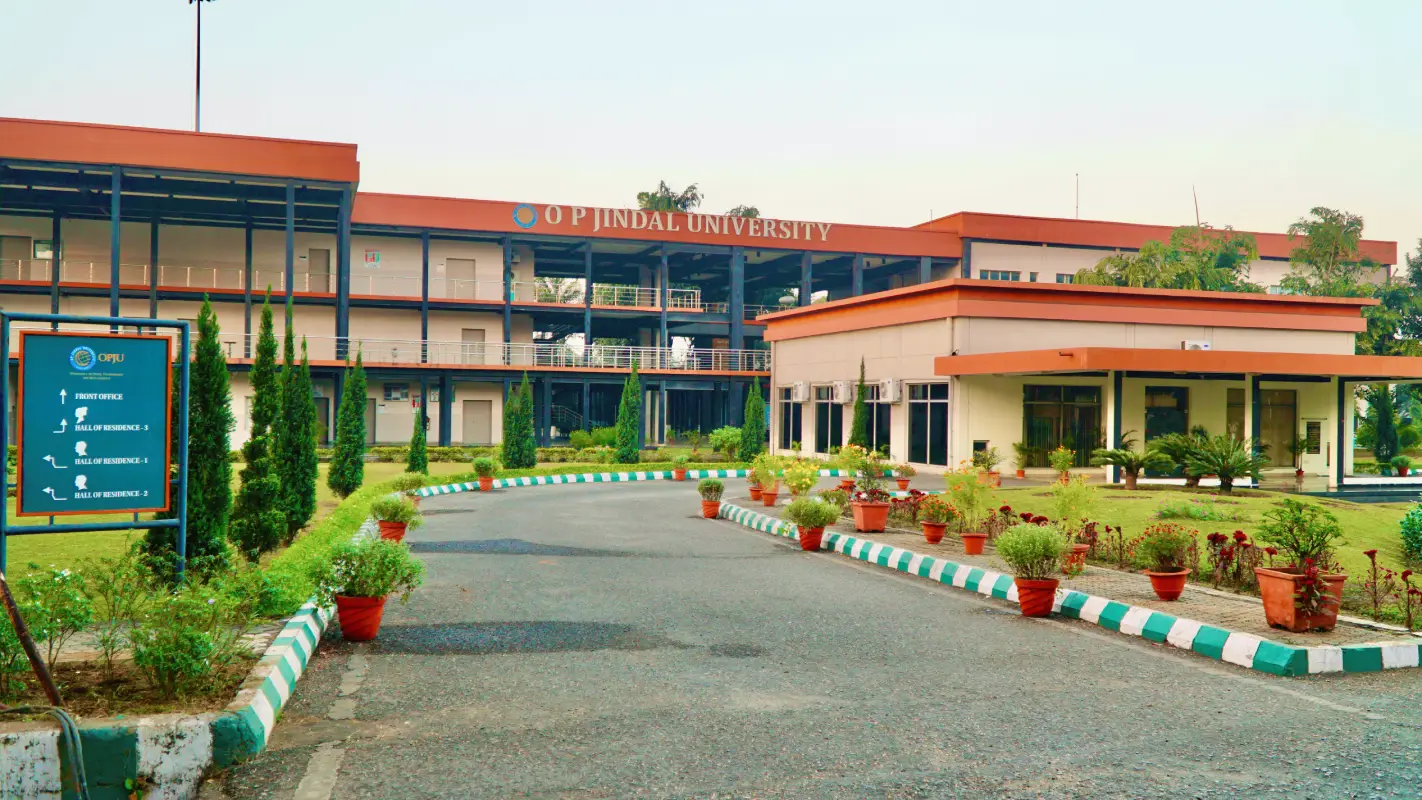
BTech CSE with AI & ML at OP Jindal University stands for Bachelor of Technology in Computer Science and Engineering with specialization in Artificial Intelligence and Machine Learning. It is a four-year undergraduate engineering program designed to prepare students for the rapidly evolving world of intelligent technologies. The program combines strong foundations in Computer Science and Engineering with advanced learning in Artificial Intelligence and Machine Learning.
At OP Jindal University, the curriculum is carefully designed to bridge academic knowledge with industry demands. Students gain in-depth understanding of core subjects such as programming, data structures, algorithms, operating systems, and database management, along with specialized courses in machine learning, deep learning, neural networks, natural language processing, computer vision, and data analytics.
The BTech CSE with AI & ML program at OP Jindal University focuses on both theoretical knowledge and practical implementation. Students are trained through hands-on laboratory sessions, real-time projects, coding practices, and industry-oriented learning modules. The program enables students to work with modern tools and technologies used in AI-driven applications.
With the increasing demand for AI professionals across sectors such as healthcare, finance, manufacturing, agriculture, and cybersecurity, this specialization opens doors to exciting and future-ready career opportunities. Students are encouraged to explore emerging domains such as robotics, predictive analytics, intelligent automation, and big data systems.
OP Jindal University provides a dynamic academic environment, experienced faculty, modern computing laboratories, and strong industry interaction to help students develop technical competence and innovation skills. The program also promotes research, internships, and project-based learning to prepare students for higher education, entrepreneurship, and global career opportunities.
For students aspiring to build a successful career in next-generation technologies, BTech CSE with AI & ML at OP Jindal University offers the right platform to learn, innovate, and lead in the era of Artificial Intelligence.
Candidates of reserved category (SC/ST/OBC) of Chhattisgarh domicile and Female candidates are exempted from Application fee.
Candidate who have requisite qualification from foreign universities or boards of Higher education recognized as equivalent to the +2 stage of India by Association of India Universities (AIU) are eligible for admission.
To view the detailed fee structure, Click Here .
To view the detailed scholarships, Click Here .
| Semester I |
|---|
| Engineering Mathematics-I |
| Applied Physics |
| Basic Electrical and Electronics |
| Engineering Graphics |
| Introduction to Engineering Materials |
| Ability Enhancement Course (Choose from Pool) |
| Skill Enhancement Course (Choose from Pool) |
| Value Added Course (Choose from Pool) |
| Basic Electrical and Electronics Lab |
| Innovation and Skill Development |
| Semester II - Course Name |
|---|
| Engineering Mathematics-II |
| Applied Chemistry |
| Semester II - Course Name |
|---|
| Engineering Mathematics-II |
| Applied Chemistry |
| Semester II - Course Name |
|---|
| Engineering Mathematics-II |
| Applied Chemistry |
| Semester II - Course Name |
|---|
| Engineering Mathematics-II |
| Applied Chemistry |
| Semester II - Course Name |
|---|
| Engineering Mathematics-II |
| Applied Chemistry |
Apply knowledge of mathematics, natural science, computing, engineering fundamentals and an engineering specialization as specified in WK1 to WK4 respectively to develop the solution of complex engineering problems.
Identify, formulate, review research literature and analyze complex engineering problems reaching substantiated conclusions with consideration for sustainable development. (WK1 to WK4)
Design creative solutions for complex engineering problems and design/develop systems/components/processes to meet identified needs with consideration for the public health and safety, whole-life cost, net zero carbon, culture, society and environment as required. (WK5)
Conduct investigations of complex engineering problems using research-based knowledge including design of experiments, modelling, analysis & interpretation of data to provide valid conclusions. (WK8)
Create, select and apply appropriate techniques, resources and modern engineering & IT tools, including prediction and modelling recognizing their limitations to solve complex engineering problems. (WK2 and WK6)
Analyze and evaluate societal and environmental aspects while solving complex engineering problems for its impact on sustainability with reference to economy, health, safety, legal framework, culture and environment. (WK1, WK5, and WK7)
Apply ethical principles and commit to professional ethics, human values, diversity and inclusion; adhere to national & international laws. (WK9)
Function effectively as an individual, and as a member or leader in diverse/multi-disciplinary teams.
Communicate effectively and inclusively within the engineering community and society at large, such as being able to comprehend and write effective reports and design documentation, make effective presentations considering cultural, language, and learning differences.
Apply knowledge and understanding of engineering management principles and economic decision-making and apply these to one's own work, as a member and leader in a team, and to manage projects and in multidisciplinary environments.
Recognize the need for, and have the preparation and ability for i) independent and life-long learning ii) adaptability to new and emerging technologies and iii) critical thinking in the broadest context of technological change. (WK8)
PSO 1: Apply knowledge of human cognition, AI, ML, and Data Engineering to analyze and solve complex real-world problems.
PSO 2: Design solutions using computational skills and innovative tools in AI, ML and DL to meet specific needs for societal needs.
PSO 3: Demonstrate acquired knowledge to lead teams or projects and involve in research and development problems.
PSO 4: Ability to adapt and quickly learn rapidly changing technologies and work environment to cater the contemporary needs of global IT industry and entrepreneurship.